I made this story on how the NYT Best Sellers List works for a class project. It includes an analysis of the list done on data from the Post 45 Data Collective and my own web scrape of the NYT website.
There is also an audio piece about this analysis here.
To learn more about the code and analysis that went into this project, you can go here. I’ve also recently updated the GitHub to automatically scrape the list each week.
What books top the New York Times Best Sellers List and why
by Aislyn Gaddis
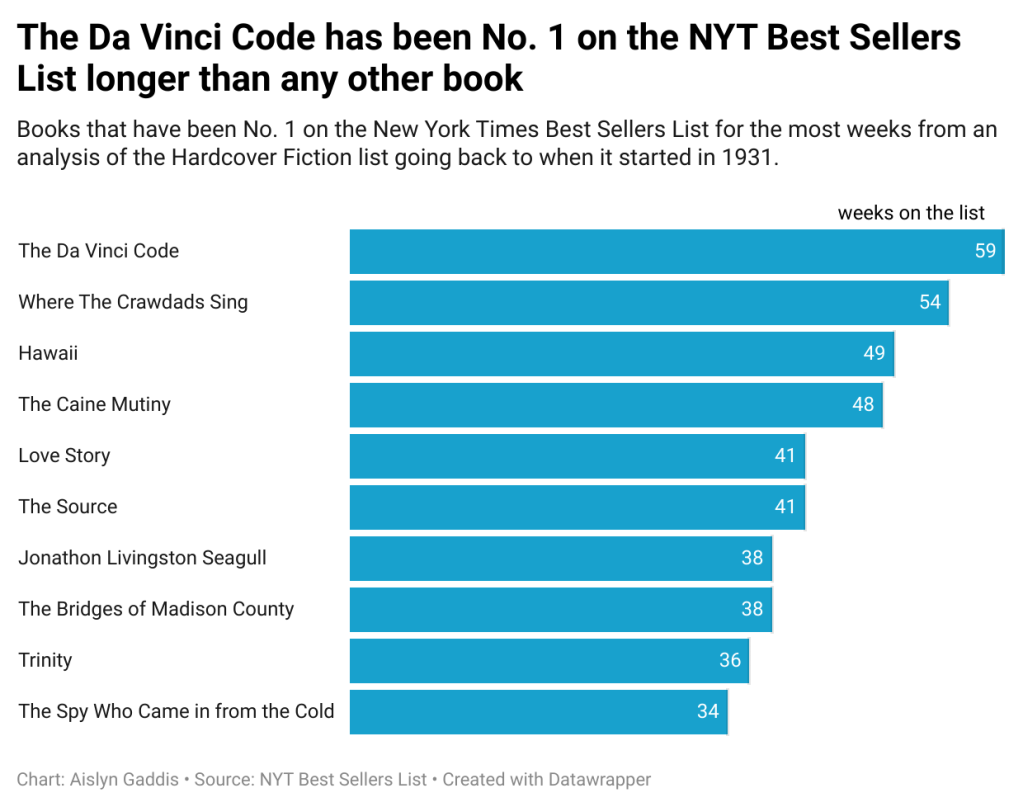
Dan Brown’s “The Da Vinci Code” may be the most successful book ever — at least according to The New York Times Best Sellers List.
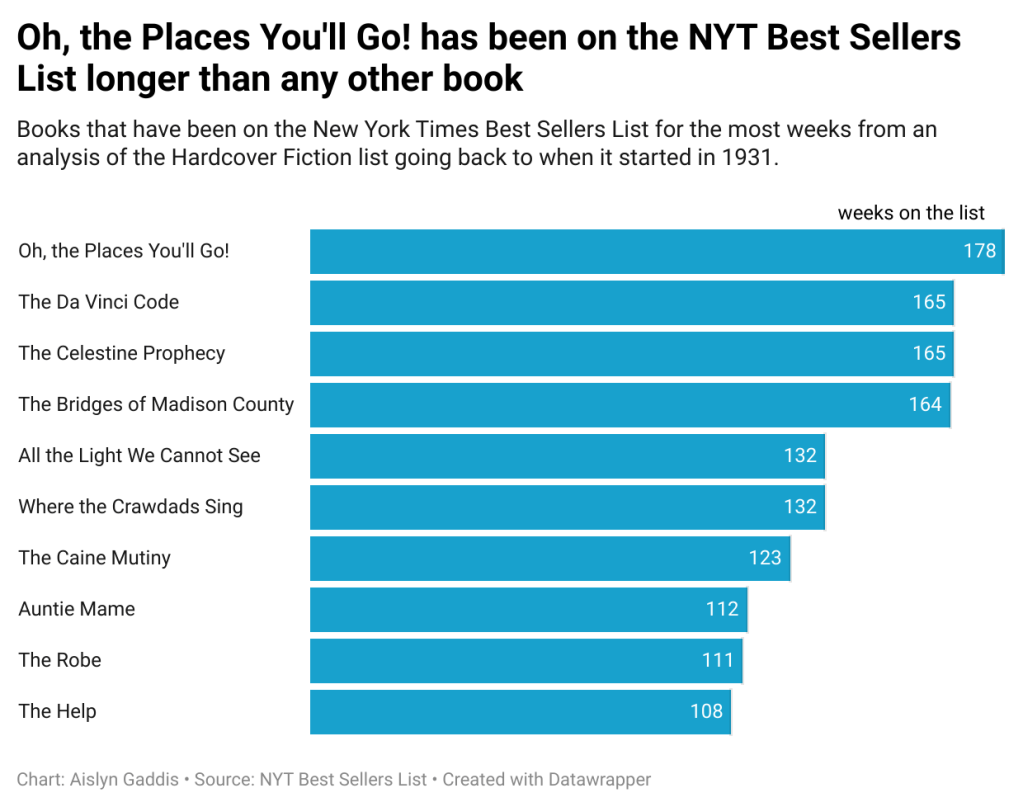
According to an analysis of the list, “The Da Vinci Code” held the top spot more than any other book, with 59 weeks, and spent the second-most time on the list total, with 165 weeks, beaten only by Dr. Seuss’ “Oh, the Places You’ll Go!”
The New York Times Hardcover Fiction Best Sellers List — the main list — comes out every week, “authoritatively ranking” the top 15 books sold in the U.S., according to their website.
While the Times’ selection process is not public, the Times has said they use book sales sampled from stores across the country — but the list is more than pure sales data.
Laura B. McGrath, a professor of contemporary literary culture at Temple University who teaches a class on best sellers, said that pre-orders matter a lot because the Times actually only looks at sales from pre-selected books. Pre-orders help the books get selected in that initial phase.
It’s thought that the Times weighs sales from brick-and-mortar stores over places like Amazon. Additionally, the particular stores that get sampled come into play, as stores from different regions will naturally have different sales.
Only sampling certain stores presents another problem, according to McGrath.
“The bestseller list really replicates many of the systems of inequality that exist in the publishing industry broadly,” she said. “Whose books are they sampling? Who are they interested in?”
The question is whether the New York Times is sampling the Barnes and Noble in Times Square that’s catering primarily to tourists or sampling an independent bookstore in Harlem that might have a customer base that’s primarily people of color. The stores they sample can yield very different results.
“The list tends to just replicate the systems of inequality within the publishing industry that already favor white authors,” McGrath said.
The Times also has a system in place to prevent publishers from trying to cheat the system. Sometimes, to inflate sales, publishers or authors will pay another party to bulk-buy a book, so the Times’ algorithm flags large purchases.
Even with the lengthy process, the rankings are not usually an indicator of lasting power or literary merit.
McGrath said that the list only looks at what sells in the short term right after the book is released, but there are also long-term best sellers.
“The most influential and significant books in American literature and in American literary history are not necessarily and mostly haven’t been bestsellers,” she said, using “Moby Dick” and “The Great Gatsby” as examples.
While “Moby Dick” was published before the list began, “The Great Gatsby” never appeared on the list.
Additionally, J.R.R. Tolkien’s “The Fellowship of the Ring” has sold more copies over time than any other book published after the New York Times Best Sellers List was started, according to Business Insider. But, “The Fellowship of the Ring” never made it on the list, nor did J.R.R. Tolkien until decades after his death. “The Silmarillion,” a collection of short stories by Tolkien, was published posthumously by his son in 1977 and appeared on the list for 59 weeks.
This explains why some of the results of the analysis were surprising.
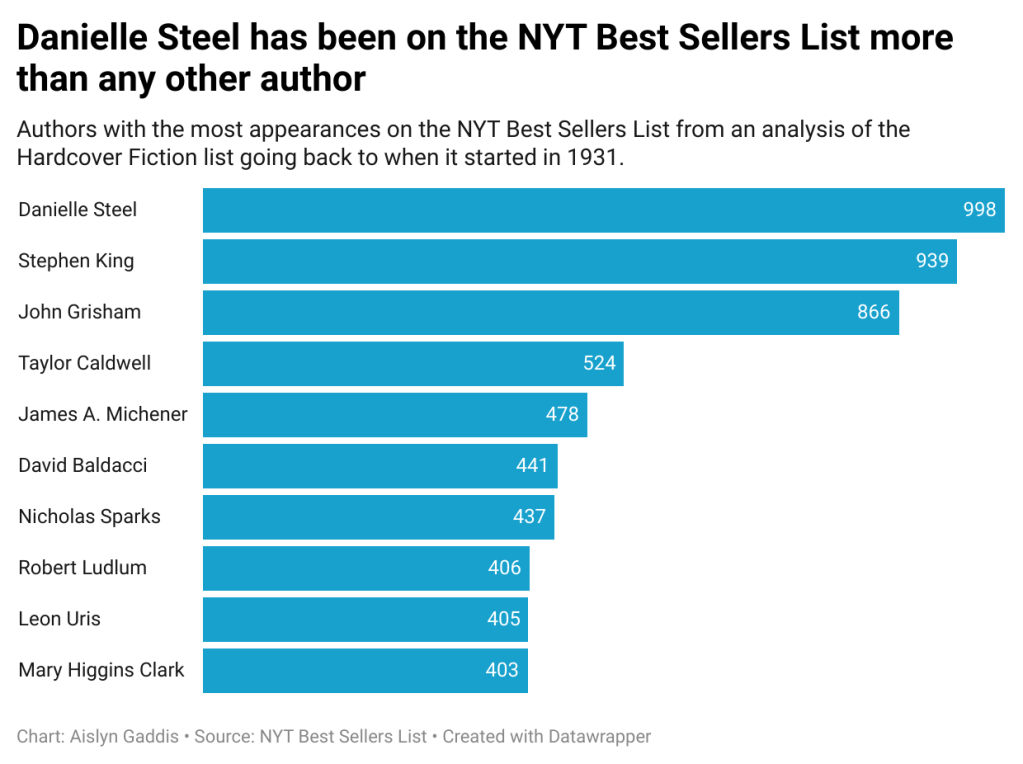
Romance author Danielle Steel has had the most appearances — excluding collaborations — on the list with 998. Horror author Stephen King comes in second with 939, and legal thriller author John Grisham comes in third — still hundreds of appearances above 4th place.
While getting on the list may not be an indicator of a book’s long-term success or impact, it’s still a go-to for many readers.
Jordan Moscheo, a freshman at the UT College of Education and an avid reader, says she gets most of her reads from the list.
She said she likes it because it’s always up to date. “It’s honest. It says what’s the most popular thing right now.”
She does get tired of the list when the same books are on it for weeks in a row. “There are times where it’s like, okay, this book should be off the list because it’s been on here for a billion weeks, but I guess that’s just what people are reading,” she said. “It doesn’t give other people a chance to get on the list.”
McGrath refers to the list as a sort of self-fulfilling prophecy. It takes readers to get on the list, but then getting on the list gets even more readers.
Consuelo Wilder, the adult book buyer at BookPeople, said the same.
“If you’re a bestseller and you’re getting noticed, that causes more people noticing and buying,” she said. “[A book] will just keep sustaining itself for a while. I think people see the list and keep returning to those books.”
Wilder’s buying decisions depend on a lot of factors, from BookPeople’s past sales data, to what its employees are reading, to information from publisher’s sales reps. Even so, Wilder said she always makes sure to keep books from both the Times’ list and the Indie Bestsellers List in stock as much as she can.
She also said she’s curious to see where the conversation about the Times list leads, especially around the secrecy of where they get their data.
“It’s been this staple in the industry for so long, and I think people are starting to question it,” she said.
Despite the secrecy and even controversy surrounding the list, it still has a grip on the industry that’s likely not going away anytime soon.
“Getting on the New York Times Best Seller List is the goal for almost every book,” McGrath said. “If you’re able to do that, that means that not just one person did their job right. Not just that the author wrote a great book, but that every single person in that [publishing] chain did their job right.”
 Aislyn Gaddis